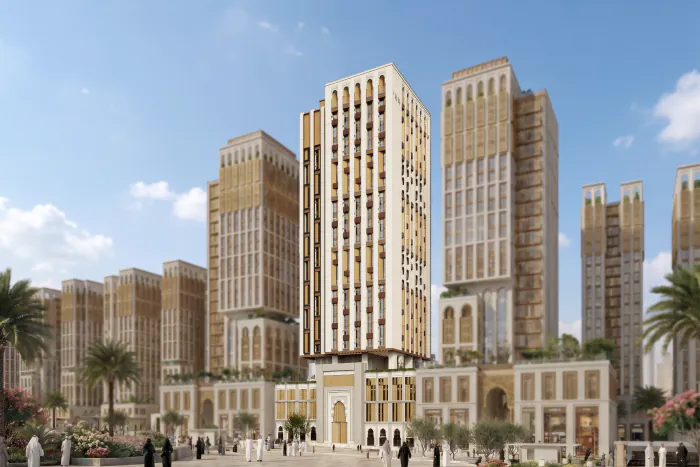
Makkah is the city of the Grand Mosque, and a home here is bought for faith and family as much as for investment. Since 22 January 2026, Muslim individuals, whether they live in the Kingdom or abroad, may own residential property in the zones designated for the city, and Saudi companies may own there for their business and to house their staff. Non-Muslims may not own property in Makkah. For the first time, a Muslim family abroad can hold a title deed in its own name a short distance from the Haram.
Property for sale in Makkah
The home we sell in Makkah is Ma'ad Tower, a new residential tower by Al Majdiah in Masar, the rebuilt western approach to the Grand Mosque, 1.7 km from the Haram. It is planned with 157 apartments and 4 commercial units, sold off-plan under Wafi: your stage payments go into a project escrow account and are released only against certified construction progress. Al Majdiah is listed on the Saudi Exchange, and its first phase in Madinah, 304 homes, sold in full to non-Saudi buyers in September 2026.
Prices, floor plans and the payment schedule come with the release, and registered buyers receive them first. Every home we sell in the city is under property for sale in Makkah.
Who can buy property in Makkah
The rules for the two holy cities differ from the rest of the Kingdom, and they are precise.
| Buyer | Position in Makkah |
|---|---|
| Saudi nationals | Own without the non-Saudi restrictions |
| Muslim individuals, resident in the Kingdom or abroad | May own residential property inside the designated zones |
| Saudi companies | May own inside the designated zones, for their business and to house their staff |
| Non-Muslim individuals | May not own property in Makkah |
| Investors in listed companies | Since 27 January 2025, may hold shares in listed companies that own real estate in Makkah, up to 49% foreign ownership in total |
Article 2 of the Non-Saudi Real Estate Ownership Law limits non-Saudi ownership in Makkah and Madinah to natural persons who are Muslim, and REGA's guide of 23 June 2026 allows them residential property inside the designated zones. Under Article 3, Saudi companies with foreign shareholders may own there for their business and to house their staff. Each purchase is registered with REGA through the Saudi Properties platform, and a buyer living abroad first obtains a digital identity approved by the Ministry of Interior. We confirm your eligibility and the parcel before any reservation; our foreign ownership guide sets out the wider law.
Most families buy in their own names. The company route is for a Saudi company's own business or the housing of its staff, so if you plan to buy through a company, take independent legal advice on the structure before you reserve; we work with your lawyer on the documents and the registration.
Where foreigners can buy in Makkah: the designated zones
The list approved by the Council of Ministers on 23 June 2026 names Abraj Makkah, Al Manar, Ajyad Tower, King Salman Gate, Tilal Village, Jabal Omar, Thakher Makkah, the Sumou suburb, Masar, and two areas called Makkah zones 1 and 2. Several are large developments close to the Haram, from Jabal Omar beside it to Masar on its western approach; Al Manar is a suburban ROSHN community. A project name on the list is a starting point: the parcel on REGA's map and the title deed decide eligibility, and we check both. The glossary explains designated zones.
Makkah property prices
Apartments in Makkah averaged SAR 3,500 per sqm at the end of 2025, down 5% on the year, and villas SAR 3,260, down 6%, the first fall in two years for both. Registered deals in Q1 2026 averaged SAR 3,437 for apartments and SAR 2,721 for villas.
Distance from the Haram changes everything. Apartments closest to the Grand Mosque routinely trade above SAR 15,000 per sqm, more than four times the city average, depending on distance, quality, views and access. At the same time, the market is moving: sales in Makkah rose 14.1% year on year in Q3 2026, while they fell in Jeddah, Madinah, Dammam and Al Khobar, with apartment prices adjusting. For a buyer, that means more evidence of what homes trade for, and an entry point after a year of softer prices.
Living in Makkah
Life in Makkah is shaped by the Grand Mosque and by the pilgrims who come to it. 1,673,230 pilgrims performed Hajj in 2025, 1,506,576 of them from outside the Kingdom, and Umrah brings visitors throughout the year. Much of the stock closest to the Haram is hotels and serviced apartments; family homes are mostly further out, in the residential districts along the ring roads.
The city around the Haram is being rebuilt. Masar is rebuilding the western approach along King Abdulaziz Road, with more than SAR 38 billion invested by the end of 2025. King Salman Gate, announced by the Public Investment Fund in October 2025, will add up to 12 million sqm of floor area beside the Grand Mosque, with residential, hospitality, commercial and cultural uses and prayer spaces for about 900,000 worshippers. Both are designated zones.
Is Makkah a good place to buy?
For a Muslim family that wants a home of its own near the Haram, yes, and for the first time that family can live abroad. A home here gives you a place for Umrah, Ramadan and family stays without booking a hotel in the busiest weeks of the year, and a title deed in your name.
Weigh three things. Resale buyers are limited to Saudis, Muslim individuals and Saudi companies, so the market when you sell is narrower than in Jeddah or Riyadh, and there is no resale record yet for non-Saudi owners. Most eligible homes are off-plan, so check the Wafi licence and the escrow account, which we send with the price list. And the hotel pipeline is very large, so treat any rent as a bonus rather than the reason to buy. On top of the price, the 5% real estate transaction tax falls on the seller by law unless the contract passes it to the buyer, and the registry fee is SAR 1,600. When a non-Saudi owner sells or otherwise disposes of a home in Makkah, the Real Estate General Authority charges a fee of 2% of the value: a cost of selling, so a short hold rarely pays. The costs and taxes guide has the detail.
Renting out a home in Makkah
A long let in Makkah averaged SAR 17,601 a year for an apartment and SAR 44,512 for a villa in 2025. Seasonal stays near the Haram follow their own calendar, peaking in Ramadan and the Hajj season, and letting by the night needs a private hospitality unit licence from the Ministry of Tourism. If the home is in a hotel-run building, ask for the operator's agreement, the split of income and costs, and your own-use rights in Ramadan and the Hajj season; we obtain them with the price list. Treat any projected return as a projection, and see our guide to short-term rentals.
Getting to and around Makkah
King Abdulaziz International Airport in Jeddah is about 70 minutes by road from the Grand Mosque. The Haramain High Speed Railway's Makkah station at Al Rusayfah, about 4 km west of the Haram, links the city to Jeddah, the airport and Madinah on a 450 km line. Trains from Jeddah reach Makkah in under an hour, so a family can land at King Abdulaziz International Airport, take the train from the airport station and reach the city without a drive on the Makkah road.